GOOGLE FEM
Empowering women to manage their health on the go
Introducing a future Android app that puts women’s needs first




INTRODUCTION
Women’s Health in Context
Women make 80% of the household healthcare decisions and spend 29% more than men on healthcare needs. With all that spending and decision-making power, It’s hard to believe how underserved women are by healthcare innovation.
FemTech Takes the Stage
Against this backdrop, FemTech has emerged as a growing sector of digital products and solutions designed to improve or support women’s health — estimated to be worth $50 billion by 2025.
A Google Challenge
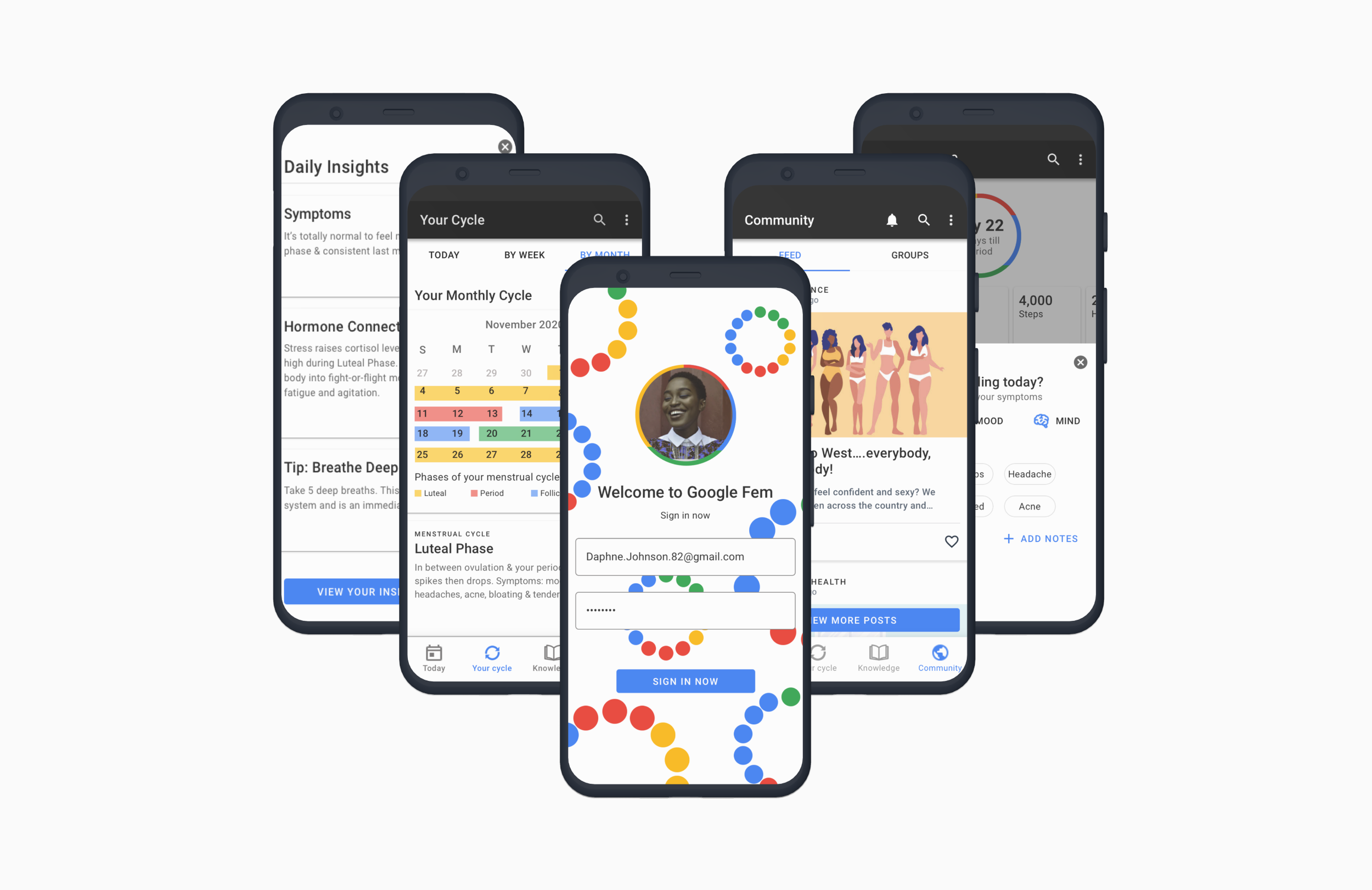
Recognizing an opportunity for Google to expand its offerings into the rising FemTech market, I created an Android prototype and branding for Google Fem, a new women’s health app. Excited by this challenge to make women’s health more accessible, I spearheaded a UX design process from a concept through developer-ready prototype.
Expertise: UX, UI, User Research
Team: UX Designer (me!)
Tools: Sketch, Invision, Airtable
Deliverables: Interactive prototype & Branding
THE PROCESS
Phase 1: Research
Learning the Landscape
Walk through my market research, competitor analysis, and empathy-driven user research, which helped me uncover key data about the target audience’s preferences, pain points, behaviors, and FemTech market trends. The insights gathered during this process informed my decision-making throughout the design and development process.
Phase 2: Strategy
Defining Problems and Priorities
Discover how research was translated into a design strategy focused on key features and functionalities that aligned with business goals and findings from my user research. This phase included problem definition, ideation, plotting product requirements roadmap, information architecture, and user flows.
Phase 3: Design
Ready, Set, Iterate…and Test!
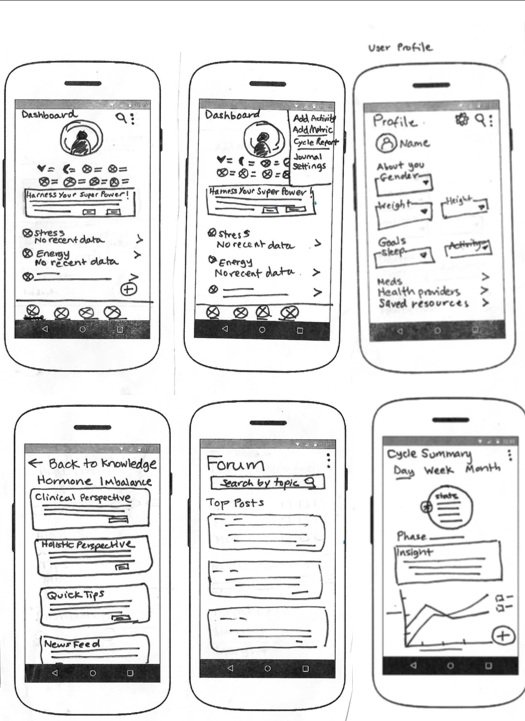
Explore the design iteration process — from low-fidelity sketches to interactive prototypes — that allowed me to effectively explore and iterate on design ideas, validate assumptions, and optimize the user-centeredness of the interfaces. This phase included usability testing and the incorporation of branding and style elements to delight the target audience.
Presenting Google Fem!
Check out the refined and validated prototype, ready to be presented to stakeholders and handed off to developers with detailed specifications and assets to guide implementation. At this stage I felt confident the result was a valuable, easy-to-use, digital health solution for women seeking support and credible information about their health issues.